The inaugural list of the Middle East & North Africa’s 50 Best Restaurants was announced in Abu Dhabi last night.
The culinary stars of the restaurant world converged in the UAE capital of Abu Dhabi last night for the debut of the Middle East & North Africa’s 50 Best Restaurants awards.
Restaurants from 11 countries within the Middle East and North Africa were announced as the top 50 places to eat in the region at an event held in Conrad Abu Dhabi Etihad Towers.
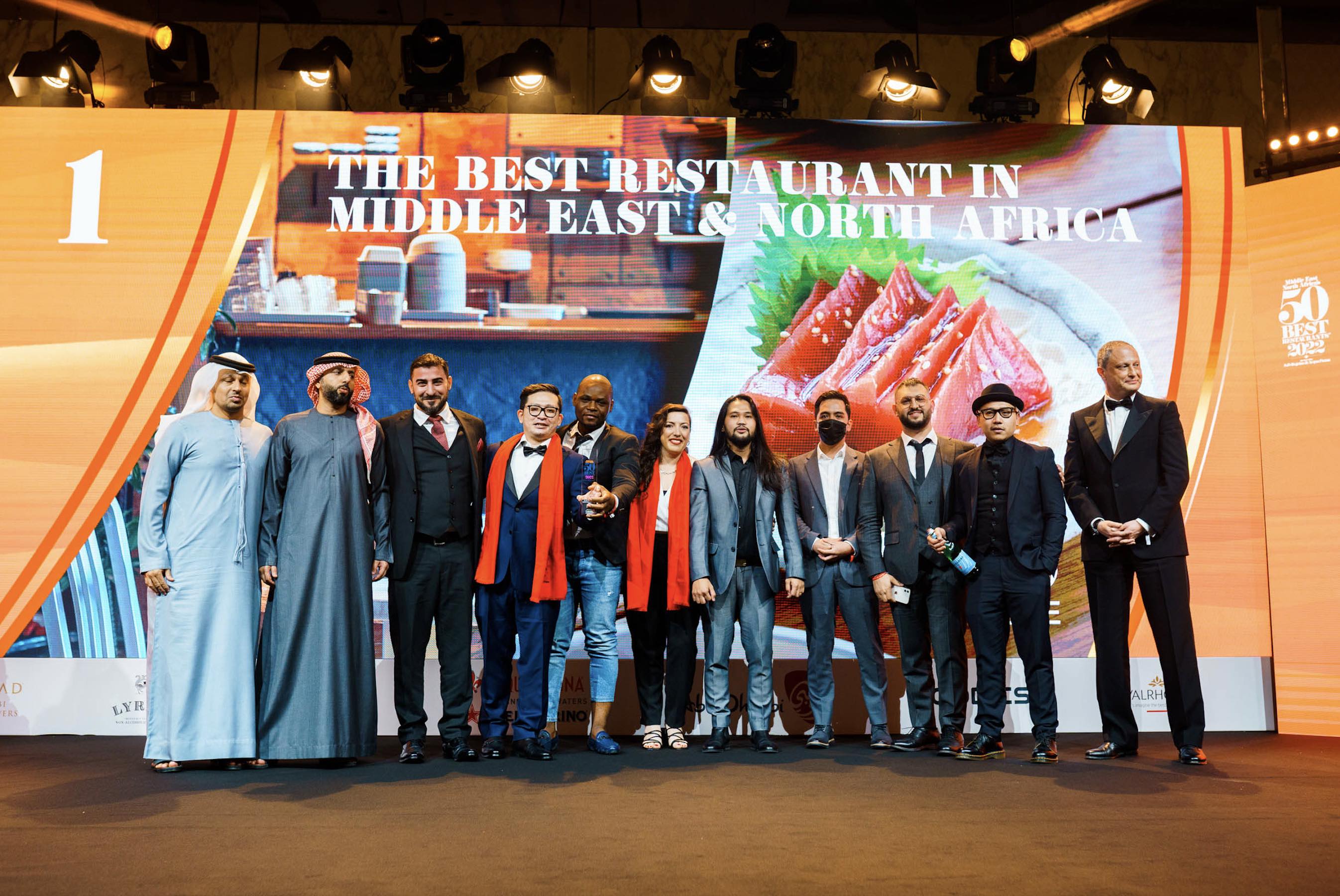
The event culminated in the announcement of the region’s first-ever No.1 restaurant, 3 Fils, whose team took to the stage to receive the award.
3 Fils, a casual contemporary restaurant located in Dubai’s historic Jumeirah Fishing Harbour, features Asian fusion dishes ranging from sushi rolls to indomie, king crab salads and marinated lamb ribs. 3 Fils is one of the most celebrated and recommended restaurants in the UAE and has now earned the highly coveted ranking as the best restaurant in the MENA region. This hidden gem prides itself on elevating every dining experience with a sense of comfort, discovery and sharing in a laid-back harbourside setting.
The Japanese izakaya Zuma in DIFC, Dubai, founded by chef Rainer Becker, claimed the No.2 spot, followed by Raz Rahav’s OCD Restaurant in Tel Aviv (No.3), which was also named The Best Restaurant in Israel.

The United Arab Emirates topped the list with an impressive 19 restaurants, including three from host city Abu Dhabi, while Israel followed with six restaurants on the list, two of which are in the top 10: OCD Restaurant (No.3) and George & John (No.9). Following close behind were Lebanon and Saudi Arabia with five restaurants each: just outside the top 10 and leading the way for Beirut is Baron (No.12), named The Best Restaurant in Lebanon, while Riyadh’s Myazu (No.15) was the winner of The Best Restaurant in Saudi Arabia title. Egypt was also well-represented with four restaurants featured in the ranking, including Sachi (No.5), making it The Best Restaurant in Egypt. Jordan also had a player in the top 10 with Fakhreldin (No.7) in Amman named The Best Restaurant in Jordan.
The anime-inspired Japanese eatery White Robata in Kuwait City comes in at No.43, making it The Best Restaurant in Kuwait, while steakhouse Cut by Wolfgang Puck in Doha (No.36) bags The Best Restaurant in Qatar award. At No.31, Mirai was The Best Restaurant in Bahrain, while Tunis restaurant La Closerie (No.46) claimed the title of The Best Restaurant in Tunisia. Three Moroccan restaurants also featured, with Marrakech’s La Grande Table Marocaine (No.26) being voted The Best Restaurant in Morocco, alongside Iloli (No.32) in Casablanca and +61 (No.49), also in Marrakech.
Popular Singapore-born chef Reif Othman was honoured with the Chefs’ Choice Award. Designed to give recognition to a chef who has had a positive impact on the regional culinary community, the award is peer-voted by chefs of the restaurants on the 50 Best Restaurants.
The Sustainable Restaurant Award honours the establishment with the highest sustainability rating. This award was presented to Lowe (No.23) in Dubai, a restaurant that has set a new standard for exquisite food that goes hand-in-hand with sustainability. Chef-owners Jesse Blake and Kate Christou focus on reducing waste through nose-to-tail cooking while also supporting their team and the wider community.
As a recognition of excellence in restaurant service and dining experiences, the Art of Hospitality Award was presented to Dubai’s Trèsind Studio (No.4). The restaurant was commended for its theatrical gastronomic experience incorporating multiple changes of pace and scenarios. Chef Himanshu Saini’s brand of advanced Indian food is matched by the perfectly choreographed service.
Sahar Parham Al Awadhi, formerly Head Pastry Chef at the esteemed Burj Al Arab in UAE, took home the MENA’s Best Pastry Chef Award, sponsored by Valrhona. Sahar began her culinary career in 2014 and has worked at La Serre Bistro & Boulangerie in Dubai with Izu Ani and Le Saint Georges in Paris. As an Emirati, she believes in showcasing the origins of her ingredients and supporting local producers.